

Tuesday, September 30, 2014
Monday, September 15, 2014
Dividing Perennials
Even though its mid September, we are already preparing for some winter projects. As you travel throughout the course, you will notice that the landscape beds are a little bare. This is because we have begun to dig up all the perennials so that we may divide them and use them in other places throughout the course. While our landscape beds are designed to be "low" maintenance, it does not mean they are "no" maintenance. If left alone, the plants would get too large and would actually begin to thin out. This is actually part of our normal maintenance program and is done every 5-7 years.
The reason for starting this now is so that it is easier for us to identify the plants after they are dug up. After we clean out the beds, we will be reorganizing the plantings so that the landscaping looks its best for next season.
 |
| Removal of ornamental grasses at #2 green. |
 |
| Ornamental grass clump that will be divided into 4 separate plants. |
 |
| #2 landscape bed after the perennials have been removed. |

Tuesday, September 2, 2014
2014 Superintendent's Revenge
A good time was had by all at the 10th annual HFCC Superintendent's Revenge Tournament. Our 2014 Champions was the team of Ernie & Joyce Franklin and Bill & Carol Miller. Here are some pics of the fun day.
 |
| Sand Pro races |
 |
| Putting with a canoe paddle |
 |
| Playing with a tennis ball and just a few obstacles |
 |
| Fun with friends! |
 |
| 2014 HFCC Superintendent's Revenge Champions |
Friday, August 1, 2014
Kyllinga
Many of you may have noticed brown spots in the fairways and the
rough. These brown areas are dying
kyllinga. Kyllinga is a very invasive
weed that is part of the sedge family and until a few years ago, was extremely
difficult to remove. With today's
herbicide technology, kyllinga is not that hard to get rid of, however the
herbicides do discolor the turf. While
the discolored turf is a bit unsightly, it is short lived and the turf regains
its color after a week. Unfortunately
there is no way around the discoloration.
 |
| Kyllinga in a fairway |
 |
| Kyllinga up close |
Monday, July 28, 2014
Fiduciary Management
As the golf course superintendent, I am often asked
questions regarding our fiduciary management practices. More often than not, the most common question
is; "How can we save money?" With
today's economy, that's a question
that we take very seriously and one that
we ask ourselves continuously. We spend
our departments budget as if the money were our own.

Chemicals and fertilizers make up a large part of our budget
and it's a place where we can stretch the dollar.
By bidding out our purchases and requiring vendors to guarantee pricing
for a season in exchange for our business, we have been able to save the club many thousands of
dollars each year. Believe it or not but
many clubs do not do this. Another way we
spend wisely is by participating in silent auctions through our professional
organizations. This year alone we saved
over $4000 by bidding on a group of products that we ultimately won.
We purchase many other types of products such as irrigation
supplies, electronics, uniforms, equipment parts, etc. By regularly doing computer searches and
using services such as ebay, we continually get products for far under normal
retail. We purchased a large amount of
used sprinkler heads this winter and reconditioned them with new parts for
pennies on the dollar compared to new heads.
This one purchase has relieved some of the shortfalls of regular
irrigation maintenance costs and has allowed us to spend more money on higher
priority items.
Another way we spend wisely is through purchasing
equipment. While we all like new, many
times a used piece of equipment will do the job just as well and help relieve
the pressures of capital purchases. There are many places that we can search for used equipment such as online forums and professional organizations. An
example of this happened recently when a 20 year old utility vehicle had a
catastrophic break down which rendered it useless. Instead of purchasing a new vehicle, we
purchased a used one in excellent condition for one third the cost of a new one
and this vehicle will do everything we need it to do for many years to come. |
| Turfnet.com is one place we look for quality used equipment. |
Thursday, July 24, 2014
HFCC environmental practices
Did you know that your golf course is environmentally
friendly? There are many practices that
we do to both protect the environment and also enhance it. While many of these practices cost more to
do, they are the right things to do.
Some of our practices are as follows:
-
HFCC uses slow-release fertilizers on all of the turf
on the course. The use of slow release
fertilizers regulates the release of nitrogen so that the plant only gets what
it needs at that time, therefore very little is wasted or washed through
the soil. We also use natural organic fertilizers that are composted from the poultry industry.
 |
| Chicken manure being composted into organic fertilizer for use on golf courses |
-
The chemicals that we use on the course are of the
highest quality and the most environmentally friendly to do the job at
hand. The products that we have at our
disposal are highly regulated for safety and application. Most products are broken down in the soil, by
soil microbes within a week or two after application. Additionally, we choose products that
chemically bind to the soil or the plant therefore reducing any chances of
runoff or leaching
 |
| Otter on the bank of one the lakes at HFCC |
-
All of our lakes are monitored monthly by Aquascapes
Environmental. Their job is to sample
all of the water entering the property, on the property, and leaving the
property. They sample for fertilizers
and pesticides so that we can better manage our practices throughout the
course. To this date, we have never
failed a test, in fact sometimes we tend to be too clean. What this means is that all the fish caught
at HFCC is safe to eat and your pets are safe to enter the water.
-
As we have been replacing aging drainpipe, some areas
have been converted back to natural streams.
This has provided habitat for fish, salamanders, crayfish, etc. which
supports larger wildlife. Additionally,
these streams are far better at controlling erosion than pipe as the streams
slow the velocity of water whereas the pipe tends to increase the velocity
which leads to more aggressive erosion.
-
Since most of our equipment is run by hydraulics, leaks
and broken hoses are a fact of life.
While the hoses are inspected daily, breaks still happen
unexpectedly. Since regular hydraulic
fluid is petroleum based, it will kill the turf and contaminate the soil should a leak occur. As a result, we use a “vegetable based” hydraulic
oil in all of our hydraulic equipment.
It costs almost 3 times more than standard hydraulic fluid but does not
contaminate the soil and does not kill the turf.
-
Speaking of equipment, we have been some of the earliest adopters of electric mowers. We
mow the greens with a hybrid walk mower that uses a small gas engine to run a
generator. The generator produces the
electricity needed for both the reels and the "wheels". This type of set up is very efficient and
uses half the fuel as traditional all gas mowers. Better yet, the quality of the cut is
superior to traditional mowers.
 |
| Electric hybrid walking greens mower |
These are just a few of the things we do at HFCC to protect
our environment. The G&G committee
and the maintenance staff understand the value of our wonderful environment
here at HFCC, its one of those features that make HFCC such a special place.
 |
| Flower bed at HFCC which provides food (seeds) for birds in the winter |
Tuesday, July 1, 2014
The American flag at HFCC
It has become a tradition at Highlands Falls to celebrate the 4th of July with a huge American flag painted on the 17th fairway. As we have just finished painting the flag, I thought it would be nice to give a brief history of how the flag came to be.
On January 1, 1776, the Continental Army was reorganized in accordance with a Congressional resolution which placed American forces under George Washington's control. On that New Year's Day the Continental Army was laying siege to Boston which had been taken over by the British Army. Washington ordered the Grand Union flag hoisted above his base at Prospect Hill. It had 13 alternate red and white stripes and the British Union Jack in the upper left-hand corner (the canton).
Between 1777 and 1960, Congress passed several acts that changed the shape, design and arrangement of the flag and allowed for additional stars and stripes to be added to reflect the admission of each new state.
Today the flag consists of thirteen horizontal stripes, seven red alternating with 6 white. The stripes represent the original 13 colonies, the stars represent the 50 states of the Union. The colors of the flag are symbolic as well: Red symbolizes Hardiness and Valor, White symbolizes Purity and Innocence and Blue represents Vigilance, Perseverance and Justice.
 |
| Painting the flag |
 |
| Painting the flag |
In May of 1776, Betsy Ross reported that she sewed the first American flag.
On June 14, 1777, in order to establish an official flag for the new nation, the Continental Congress passed the first Flag Act: "Resolved, That the flag of the United States be made of thirteen stripes, alternate red and white; that the union be thirteen stars, white in a blue field, representing a new Constellation."
On June 14, 1777, in order to establish an official flag for the new nation, the Continental Congress passed the first Flag Act: "Resolved, That the flag of the United States be made of thirteen stripes, alternate red and white; that the union be thirteen stars, white in a blue field, representing a new Constellation."
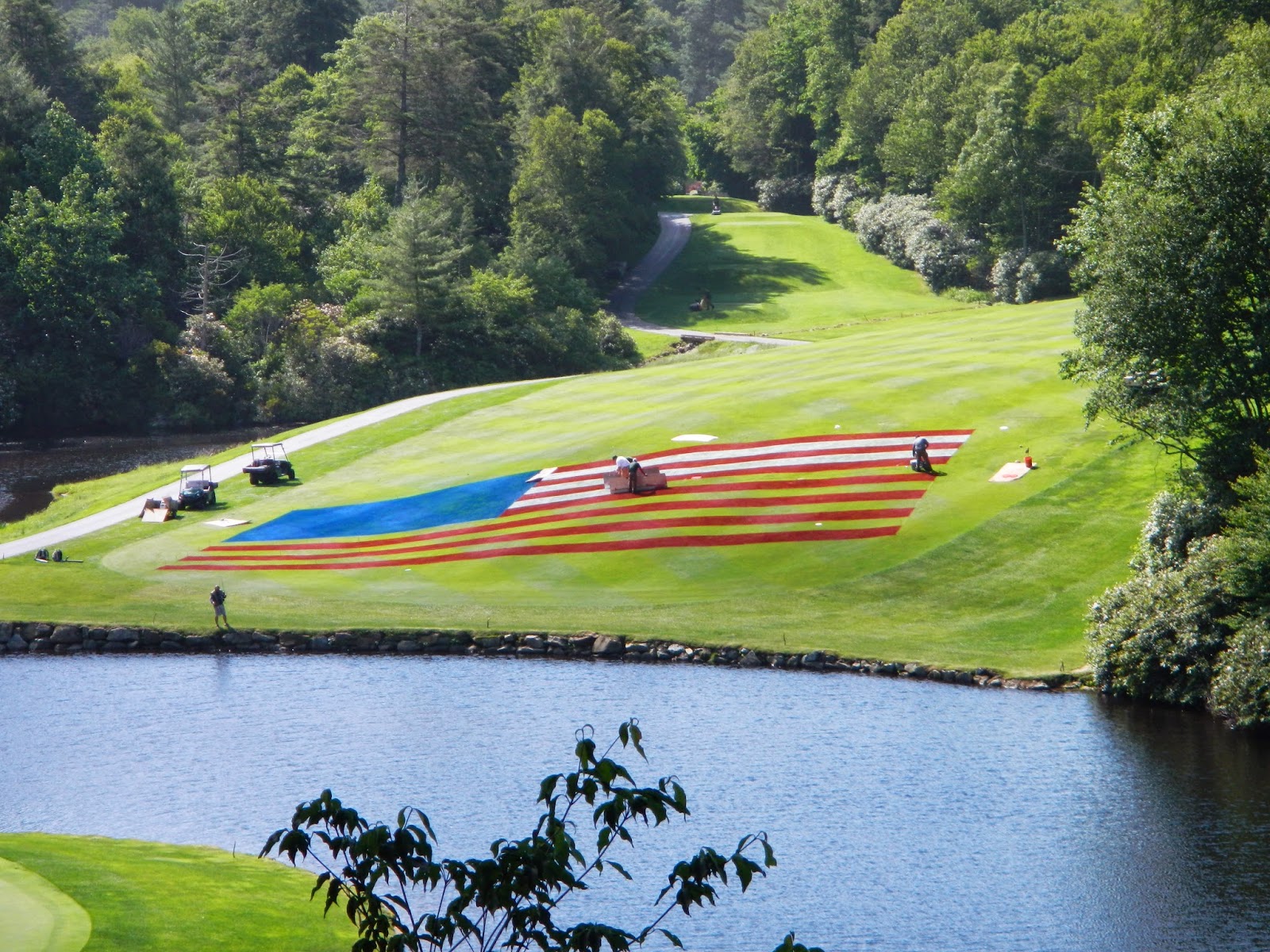 |
| Painting the flag |
- Act of January 13, 1794 - provided for 15 stripes and 15 stars after May 1795.
- Act of April 4, 1818 - provided for 13 stripes and one star for each state, to be added to the flag on the 4th of July following the admission of each new state, signed by President Monroe.
- Executive Order of President Taft dated June 24, 1912 - established proportions of the flag and provided for arrangement of the stars in six horizontal rows of eight each, a single point of each star to be upward.
- Executive Order of President Eisenhower dated January 3, 1959 - provided for the arrangement of the stars in seven rows of seven stars each, staggered horizontally and vertically.
- Executive Order of President Eisenhower dated August 21, 1959 - provided for the arrangement of the stars in nine rows of stars staggered horizontally and eleven rows of stars staggered vertically.
Today the flag consists of thirteen horizontal stripes, seven red alternating with 6 white. The stripes represent the original 13 colonies, the stars represent the 50 states of the Union. The colors of the flag are symbolic as well: Red symbolizes Hardiness and Valor, White symbolizes Purity and Innocence and Blue represents Vigilance, Perseverance and Justice.
 |
| The American flag at HFCC |
Subscribe to:
Posts (Atom)