Monday, June 10, 2019

Bill Bergin's "Mobile Office"

  With a tight schedule for adequate planning, we have been setting the groundwork as though there will be a positive vote on June 26th for the renovation of the golf course.  We still have to interview construction companies, define contracts, submit bids for materials, and much more.  To this end, our course architect, Bill Bergin has been a huge asset.

Bill and Matt Bergin
 While our project is just one of many that Bill has active now, he has made himself available for meetings, phone conversations, and changes to the plan.  It is not uncommon for Bill to drive 2000 miles per week, which makes his availability to the club even more impressive.  It has been important for him to have his personal attention on every detail up to this point. 


Bill in front of one the work stations
   In an effort to keep up with his commitments, Bill recently purchased a "rolling office" in the form of an Airstream Interstate.  According to Bill, the mobile office allows him to work on plans and conduct business while he is on the move between projects.  His son Matt does most of the driving while he works in the back.  The office has two work stations, a restroom, a kitchenette, and room for survey equipment and of course, golf clubs.


Monday, June 3, 2019

Smooth Greens

  Smooth greens do not happen by accident.  Good agronomic practices, equipment, weather, and turf type all play major roles in how well your putt rolls across a green.  

  On the agronomic side of the equation we regularly apply sand to the greens.  This helps to manage thatch but also helps to fill-in imperfections on the green's surface.  We also apply growth regulators to the greens.  This helps to manage the different growth rates between the varying types of grass we have on our greens.  The result ends up being less "bumpy" turf.

Rolling helps to smooth green the surface.
  Having the right mix of equipment to manage the surface of a green is very important.  While a good mower is obvious, attachments to the mowers can make a greens surface even better.  A product that we have started using this year is the Turf Trainer.  Developed by golf course superintendent and friend Rodney Hine.  The Turf Trainer is basically a piece of artificial turf that is drug across the green to stand the turf up before being cut.  It also helps to push sand into the turf canopy which is a desirable trait.  It punches well above its weight and continues to impress.

Turf Trainer is being used regularly on our greens.

Turf Trainer simply attaches to the bucket of a mower.
  On the weather side of the equation we tend to want to have relatively warm, dry days.  Dry weather gets rid of unwanted moisture at the surface of the greens and allows the ball to roll quick and smooth.  While dry weather forces us to work harder (hand watering), the condition allows us to more accurately manage the green's surface.

  Turf type is also a major consideration for smooth greens.  New turf varieties tend to be dense and upright which results in better ball roll.  New courses and renovated ones generally have one or two varieties of turf on their greens, while older courses tend to have a mix which is the result of mutations and infestations of weeds such as Poa anua.  Its very hard to make greens that have many different turf types to be consistent hence the use of growth regulators.  
  

Monday, May 6, 2019

Firewood Donation

  Over the winter we do so many projects that I sometimes forget that some of our work has real meaning outside of the club.  As part of our tree removal project, we generated a LOT of firewood, far more than we would use in a season.  Onifer Wilmoth our fitness director, put me in contact with Eddie Wells and Leonard Holden of the Jackson County Department on Aging.  As part of Project Fire, these gentlemen along with many volunteers provide firewood to the elderly who struggle to heat their homes during the winter.

Our staff loaded 10 dump truck loads of firewood.
  I was reminded of the donation of firewood because I just received this letter from the Jackson County Department On Aging thanking the members of Highlands Falls Country Club.  It's nice to know that some of our projects on the course have a far greater reach than just the boundaries of Highlands Falls.


Monday, April 29, 2019

HFCC Community Service

Even though it is our busiest time of the year, we made time to give back to our community.  Today part of our staff is busy helping out at the Peggy Crosby Center.  They are spreading mulch and planting perennials in an effort to improve the landscaping.  The Peggy Crosby Center provides affordable office space to organizations offering community services.  Their tenants provide much needed assistance to those living in Highlands and in western North Carolina. 
Team effort planting
Planting perennials
Blowing the parking lot
Hauling mulch

Friday, April 5, 2019

Recycling Trees on the Course

This winter the maintenance staff removed approximately 1000 trees throughout the course.  This included small diameter trees along with large white pines and dead hemlocks.  While most of the trees were reduced to chips by way of the chipper, we were still saddled with what to do with the large trees.  Hauling these to the dump would get expensive as we would incur the cost of hauling plus the dump fees. We also asked several saw mills if they wanted them but none were interested.


We decided on another plan and contracted a portable sawmill service.  Knowing what we know now, this probably should have been our first plan. We have had most of the logs milled into boards and beams that we can use for future projects.  This has been a great opportunity for us to recycle what would otherwise be waste.   Two possible future projects that we may use this lumber for are a privacy fence along the property line on hole #5 and a simple pole barn for storing equipment.


Monday, March 25, 2019

The Future Looks Bright - Millennials

The future looks bright, not just as it relates to the golf course, but also with the young people we have working for us on the golf course, Millennial's.  We have all heard the stereotypes of Millennial's; their entitled, their lazy, their snowflakes, they all want trophies, they want special privileges, etc.  I've even been guilty of believing some of these stereotypes.  However my experience with Millennial's has been anything but the typical stereotype.

Gonzalo, Mark, Nick, Levi, Davis, Cole, Chris, Aaron.  Not pictured Jason & Adam.
Approximately two thirds of our staff is classified as Millennial's, those born between 1981 and 1996.  These are some of the hardest working people that I have ever had the pleasure to lead.  I have had my challenges with this group, mostly because I don't always understand what motivates them, but they continue to make me believe they are worthy of my generation's admiration.

As hard of work as there is, tree removal in a ravine.  All the trees had to be brought out by hand.
A few take-aways for this group;
  • Millennial's like teamwork.  Time and time again I have watched more experienced employees reach out to teach a less experienced employee how to do a task.
  • They like flexibility.  Millennial's want time off and they don't want to do the same job over and over again.  The time off thing has taken some time to get used to but I have embraced it and have been rewarded for it with dedicated and hardworking employees.  As for doing the same job over and over, I have always preferred cross training employees and this group loves it. 
  • Millennial's are glued to their phones.  No arguing this one as most generations today are glued to them.  I gave up the fight to listening to music on the course a long time ago and the phone falls into the same category.  I have seen no downturn in crew productivity by allowing the phones.  In the end, our employees are happier at work and I can call them on the course if I need them.
  • Millennial's will work hard if they believe in their leaders and the company they work for.  You have to engage this group.  Let them know what the big picture is and what their role is in it.  I am always trying to let them know why they are doing something on the course and why it is important to the membership.  I also share all the comments I get from members sharing their gratitude for the staff's hard work. 
A break from work.  Camaraderie at El Manzanillo
By focusing on all of our employee's needs, we have been able to create a multi-generational staff that's able to punch above it's weight, and thanks in no small part to a bunch of Millennial's.  

All Millennial's need their phone.


Monday, March 18, 2019

Sink Hole on #18

When it rains it pours and as of today, we have had 30 plus inches of rain this year.  That rain has highlighted some deficiencies on the course, most notably rusted steel culverts.  While we have replaced most of the steel culverts, there are some that remain such as the one that travels across the fairway on #18.
Sink hole on #18
After our last major rain event, we were welcomed by a large sink hole in the middle of the fairway on #18.  At the surface was what looked to be about a 5 foot hole, but upon further inspection, there was a much larger cavity below the sod.  We immediately closed the hole for safety reasons.  It did not take long to figure out what the problem was, a rusted 18 inch steel culvert.
Digging out the old pipe.

Front of #18 green
Since the pipe was too deep for our staff to safely replace, we solicited bids to have the pipe replaced with double wall plastic pipe.  This pipe will last for well over 50 years.  While the job seems simple enough, there are electrical wires and irrigation pipes that have to be avoided.  Additionally, all subsurface drain lines need to be connected to new pipe.  With good weather, I expect this work to be completed by the end of this week.
New pipe extends all the way to the lake.

Monday, February 11, 2019

Golf Industry Show - San Diego 2019

  Josh and I have just returned from our national conference otherwise known as the Golf Industry Show (GIS).  With a golf course renovation on the horizon and our continued goal to improve the efficiency of our operation, we had several objectives that we hoped to accomplish while at the conference while also networking with various industry professionals.

Myself with my former assistant John Gruneisen.
  Over the years, we have used a record keeping program that helped us track equipment repairs, chemical usage, labor, and the overall budget.  However, with today's technology, it became clear that our old program was no longer efficient and was time consuming.  On the trade show floor we set out to find what we thought would be the best turf management system for our operation.  There were many to choose from but it seemed they were always lacking one component or another.  Then we came upon Turfkeeper.  Turfkeeper is a cloud based system that gives us more efficient control over staff management, task planning, equipment management, inventory control, chemical applications and recording, and budgeting & expense management.  This new tool will greatly reduce the amount of paperwork that we currently do and is step forward in efficiency for our operation.


Turfkeeper turf management system was developed by golf course superintendents.
  Another objective to attending the GIS was to decide on what type of grass we want on greens and fairways.  While it is obvious we want bentgrass, there are many new varieties that are FAR superior to what we currently have.  The new varieties use less water, are resistant to diseases, are more aesthetic, and can accommodate faster green speeds.  We spoke with seed researchers and took classes on using the newer varieties on course renovations.  While we have not decided on a final variety of turf, the discussions and education with other industry professionals has helped us to narrow it down to a few varieties.  This is a decision that we will have to make soon so that the sod farm has time to grow what we will need.


"The Agronomics of Golf Course Renovations"
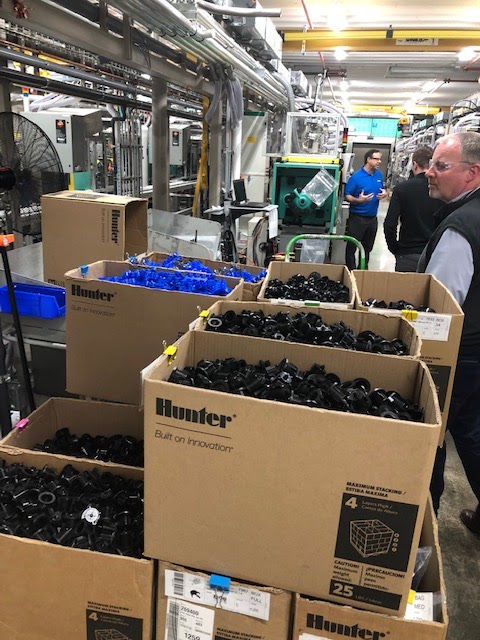
  I personally spent a day touring the Hunter Industries plant in San Marcos.  Hunter is the manufacturer of Highlands Falls irrigation system and has been a great supporter of our operation for over 20 years.  It was an eye opener to see how the sprinkler heads and controllers we use are made.  The best part was talking with the factory workers and engineers and see the pride they take with manufacturing their products.  This was an opportune time to see the operation as we will be replacing a large number of sprinklers on the course when go through the renovation.


Hunter builds over 10 million pgp sprinkler heads per year.

Sprinkler head manufacturing is almost totally automated.
  Lastly, one of the major objectives to attending the GIS is interacting with my peers.  The amount of knowledge that I gather from simply “talking turf” with the guys is immeasurable. I would like to thank everyone at HFCC for providing Josh and myself the opportunity to participate in the GIS and for understanding the value in continued education. By attending the trade show and participating in the educational seminars, I have consistently been able to bring back useful information that has benefited the Club both in savings and efficiencies, not to mention the agronomic information that improves the course.

Monday, January 28, 2019

Safety First

 I sometimes forget that not every workplace puts safety first for their employees.  The training can be time consuming and supplies can get expensive.  However, the cost for not making safety a priority could be serious injuries or even worse.

  I was recently reminded why we put such an emphasis on safety.  As most know, our staff is working on a tree clearing program in anticipation of a golf course renovation.  This is an all staff on board project that has everyone involved with cutting and chipping trees.  Even with the best safety precautions in place, accidents can happen.  While cutting a tree, one of our staff members simply got tired and let his running chainsaw slip down to his side, striking his leg.  Fortunately, he incurred no injury because he was wearing chainsaw chaps.

These safety chaps saved one of our staff members from serious injury.  After any of the chaps gets a tear or rip, they are discarded as their safety ability is diminished.

  Nobody on our staff is permitted to operate a chainsaw without wearing safety chaps, hearing protection, and eye protection.  Additionally, nobody is allowed to operate a saw by themselves, they must always have a partner just in case.  The entire staff is required to watch safety videos on a regular basis.

Fully equipped with safety gear.

  Some workplaces may think this is a little excessive, I personally think its just a starting point and an investment worth while.  Total cost for each employee to be safely trained and equipped for operating a chainsaw; safety training via video - $40, chainsaw chaps - $40, eye protection - $10, hearing protection - $20, gloves - $10, bump cap - $20.  Total cost = $140 per employee.  Total cost for an employee who is safety minded - PRICELESS.

Monday, November 12, 2018

Winter Tree Removal

  As part of our winter work, we plan on removing a large amount of trees throughout the course.  Course architect, Bill Bergin and myself have been studying the course and selecting trees for removal.  While some of the tree work needs to be done now (due to death or decay), other tree removal is in anticipation of a course renovation.
Bill and I mapping which trees are to be removed.
  By doing the tree work now with our staff, we can save the club a considerable amount of money than by waiting for the renovation and having a contractor do it.  Our staff was scheduled to start the tree removal this week, unfortunately rain has delayed our start.  We will begin as soon as the weather clears.

Monday, September 3, 2018

HFCC Installs Irrigation System for Historical Society

  In keeping with Highlands Falls Country Club's commitment to give back to the community, our staff recently finished installing an automated irrigation system for the Highlands Historical Society.  This system will help maintain and protect the health and beauty of the gardens at the historical society. 
  While several staff members had a hand in installing the system, Davis Wilson and Levi Warren deserve recognition as they did most of the installation.  Also a big thank you to Kevin Johnson of Hunter Industries for donating the sprinkler heads, valves, and controller.  This was a fun project and a special one knowing that we played a small part in protecting and highlighting the history of Highlands.
Article from the Highlands Newspaper.

Monday, August 27, 2018

HFCC Honey Harvest

In between battling the elements and preparing the course for play, we made time to harvest honey from our collection of 6 hives.  I have been told that this was not a particularly good honey year due to all the rain this season.  Even so, I am happy with the amount that we collected.  As soon as I have labels, the honey will be for sale in the golf shop.

First, we smoke the bees to calm them down.
Each frame is inspected for honey.  The best are removed for harvesting.
The wax capping must be punctured so that the honey can be released from the comb.
The frame is then put into an extractor where the honey slung out.
The honey goes from the extractor through a filter and into a food grade bucket.
Lastly, the honey is bottled.

Wednesday, July 4, 2018

A July 4th Tradition at HFCC - The American Flag

The weather on Monday was outstanding and it provided ideal conditions to paint the American flag.  The job went nearly perfect and we again have that beautiful sight on the 17th fairway.  Additionally, I want to thank all the members for sending me pictures of the flag with your drones.  Its truly a stunning sight from the air.  

Assistant Superintendent Josh Cantrell after finishing the flag.
 

For about 14 years now, the HFCC maintenance staff has been painting the American flag on #17 fairway.  17 was chosen as it provided a perfect position for the flag to be seen from the clubhouse.  The flag measures 100 feet across and takes over 1500 feet of twine to set up.  We use 10 gallons of red, 10 gallons of white, and 5 gallons of blue turf paint in addition to a case of white spray paint.  We also go through a few pairs of old shoes and pants. From start to finish, it takes approximately 4 hours to complete.


Wednesday, March 14, 2018

A Week In Pictures

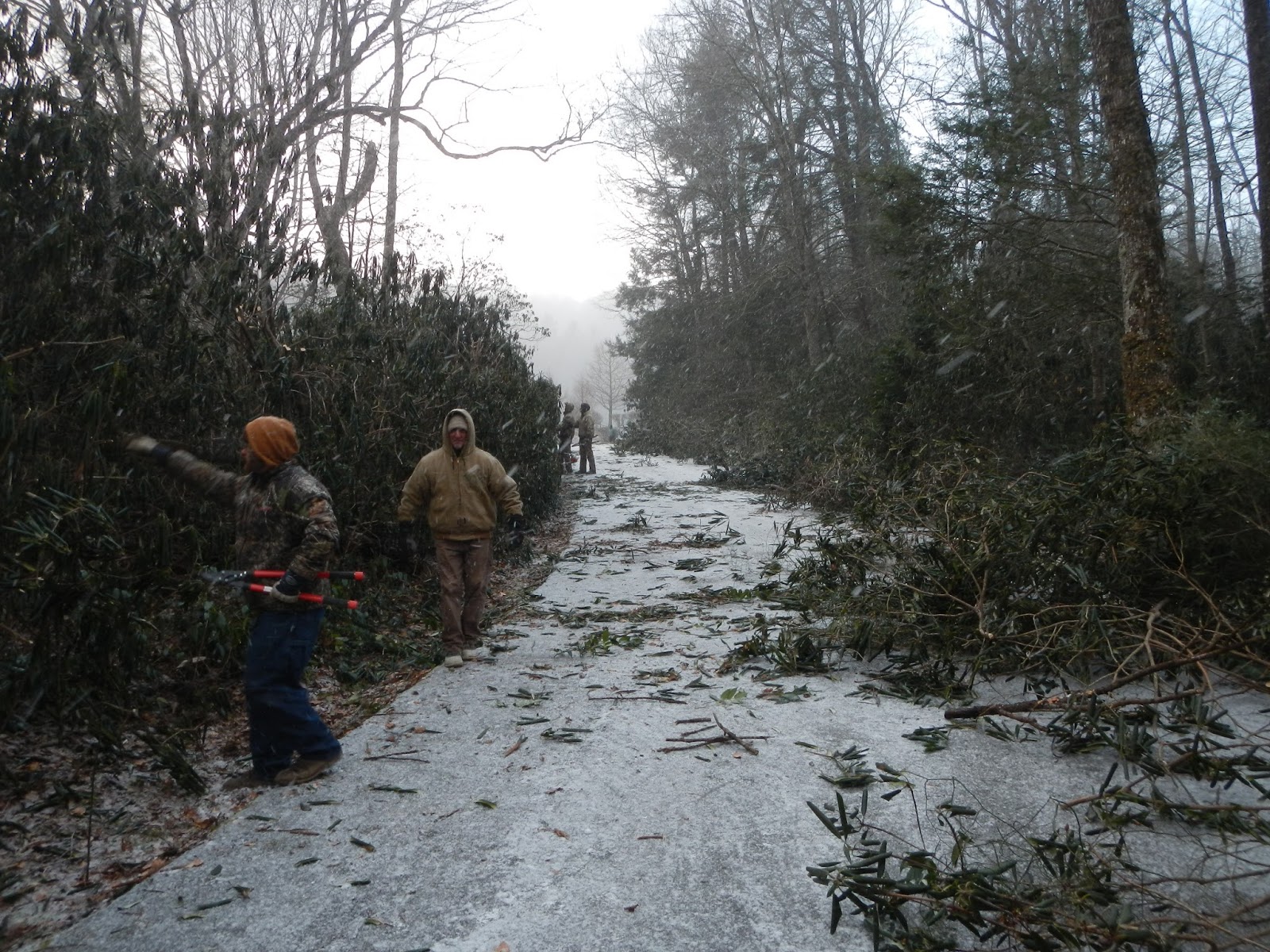
From rain, to sun, to snow, we have seen every form of weather this winter.  I previously reported how it rained during most of the month in February.  With just two and a half months into the year, I believe we had about 30" of rain.  This week, we are down to 19 degrees and snowing!  It is winter though and the crew has been tremendous and are making headway on all of our winter projects.  Amazing how much coffee and donuts will motivate a person.  Here is a brief pictorial of what we have been working on.

Installing drainage behind #4 green.

Ditch cleaning along #3.

Wet weather springs have popped up throughout the course.

This past Monday on the croquet court.
Wednesday on the croquet court.

Clearing the rhodos at the driving range entrance.

Donuts and coffee keep everyone happy.
Work on all the equipment continues in preparation for the season.